
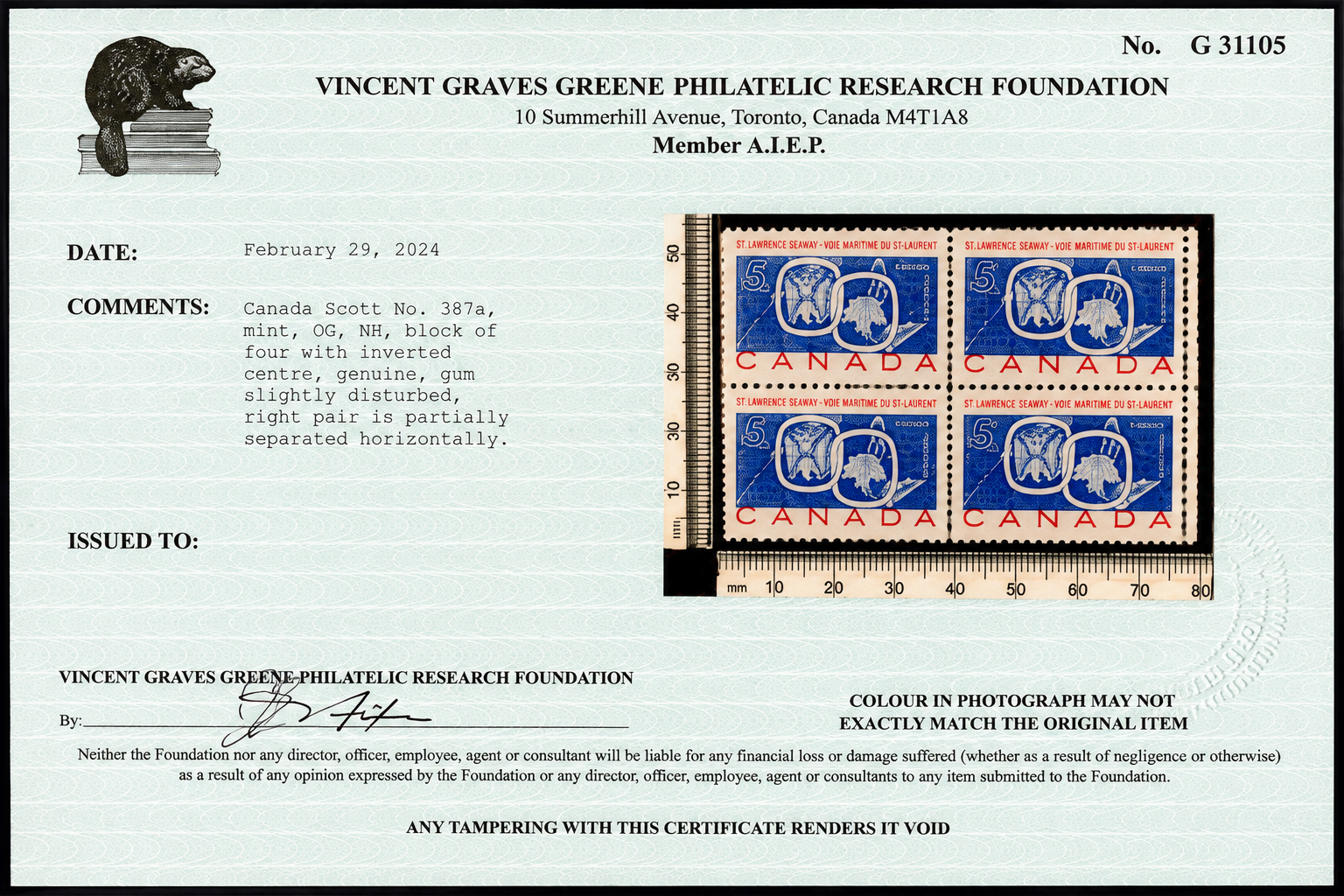
One of Canada’s most recognizable stamp-printing mistakes will return to the auction spotlight later this month when R. Maresch & Son offers a block of four 1959 St. Lawrence Seaway inverted-centre stamps as part of its Oct. 28–29 sale.
The celebrated error, which resulted from the central design being printed upside down, remains one of the best-known mistakes in Canadian philately. Its appearance in Sale 592 provides a focal point for an auction featuring everything from early Queen Victoria material to Newfoundland pence issues and British Commonwealth high denominations.
The Aurora, Ont., auction house will offer 895 lots over two days, with Canadian and Newfoundland material dominating the opening session before the sale turns to British Commonwealth and worldwide stamps.
Offered as Lot 392, the St. Lawrence Seaway inverted-centre block of four (Scott 387a) is mint never hinged and accompanied by a February 2024 certificate from the Vincent Graves Greene Philatelic Research Foundation.
The certificate confirms the error is genuine, while noting slightly disturbed gum and partial horizontal separation affecting the right pair. The block carries a catalogue value of $12,500.
The five-cent stamp was issued in 1959 to commemorate the opening of the St. Lawrence Seaway, a major engineering project connecting the Great Lakes with the Atlantic Ocean. Its inverted-centre variety became one of Canada’s most widely recognized modern stamp errors.
Collectors specializing in Canada’s classic period will find several noteworthy offerings.
Lot 134 features a black plate proof of the 12-pence Queen Victoria stamp with a vertical carmine SPECIMEN overprint. Printed on India paper, the proof is described as very fine and carries a catalogue value of $3,000.
The 12-pence denomination is among the most celebrated of Canada’s early stamp designs, and surviving proofs offer collectors an opportunity to study the production of these classic issues.
Another offering, Lot 294, is a six-cent brown imperforate pair from the Queen Victoria Numeral issue (Scott 80a). The pair retains original gum, with a thin gum skip noted in the description, and is accompanied by a 2009 Gratton certificate. Its catalogue value is $1,500.
Lot 384 adds another dimension to the Canadian material with a mint never-hinged imperforate block of four of the two-cent New Brunswick stamp (Scott 210a). Described as very fine, the block carries a catalogue value of $2,975. The auction house notes only 45 pairs are known.

A complete sheet of 40 Newfoundland five-pence violet-brown stamps, including seven showing portions of the STACEY watermark, is among the highlights of R. Maresch & Son’s upcoming auction. Offered as Lot 511, the sheet carries a catalogue value of $11,280.
An especially striking offering is Lot 511, a complete sheet of 40 Newfoundland five-pence violet-brown stamps (Scott 12A, 12Ai).
The sheet includes seven stamps displaying portions of the STACEY watermark, an important feature for specialists studying Newfoundland’s early issues.
Although a horizontal fold is present between the first and second rows, the stamps are described as never hinged and very fine. The complete sheet carries a catalogue value of $11,280.
Newfoundland’s early stamps remain an important collecting field, reflecting the colony’s separate postal history before it joined Canada in 1949. Complete sheets provide an opportunity to examine stamp arrangements, production characteristics and varieties not always evident in individual examples.
The second day of the auction broadens the selection beyond Canadian philately.
Among the British Commonwealth offerings is Lot 644, a Gibraltar King George V £5 violet and black stamp (Scott 93).
The mint never-hinged stamp is described as very fine and bears a small Georg Bühler guarantee backstamp. Maresch notes the stamp is unpriced in never-hinged condition, although its listed catalogue value is $1,850.
Worldwide material includes Lot 792, consisting of two decorative souvenir sheets issued by Czechoslovakia in 1934 to commemorate the country’s national anthem.
Printed on thick card without gum, as issued, the sheets are described as very fine and carry a combined catalogue value of $1,010.
The first session, covering lots 1–585, begins Wednesday, Oct. 28, at 10 a.m. Eastern. The second session, featuring lots 586–895, follows Thursday, Oct. 29, at the same time.
The auction will be conducted without floor bidding, although collectors can participate through live Internet bidding on Stamp Auction Network. Mail, telephone and email bids will also be accepted.
American collectors should also be aware of the additional 50 per cent U.S. tariff affecting Canadian philatelic material, which the auction house has advised may apply to purchases shipped across the border.
The complete catalogue, photographs and bidding information are available through R. Maresch & Son’s Sale 592 on Stamp Auction Network.