
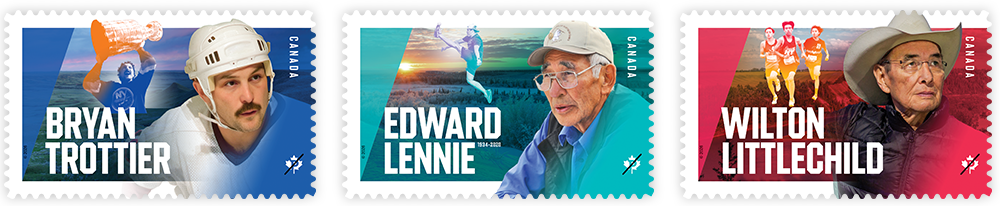
The legacies of three Indigenous sports leaders who inspired generations of athletes and helped strengthen cultural pride across Canada are being celebrated on a new three-stamp issue released ahead of National Indigenous Peoples Day on Sunday, June 21.
The 2026 issue honours hockey legend Bryan Trottier, Arctic sports advocate Edward Lennie and former athlete, lawyer and Indigenous rights champion Chief Wilton Littlechild. The stamps represent the fifth annual instalment in a series recognizing contemporary First Nations, Inuit and Métis leaders who have dedicated their lives to preserving Indigenous culture and improving the quality of life of Indigenous Peoples across Canada.
Each stamp combines portraiture with imagery reflecting the life, achievements and legacy of its subject.
The Bryan Trottier stamp features a portrait of the six-time Stanley Cup champion alongside an image of him raising hockey’s most famous trophy. A prairie landscape forms the backdrop, highlighting his roots in Val Marie, Sask. Widely regarded as one of hockey’s greatest players, Trottier won six Stanley Cups and five major National Hockey League awards during his Hall of Fame career. Of Cree, Métis, Chippewa and Irish heritage, he later co-founded the Aboriginal Alumni Hockey Team and has spent years visiting communities across Canada, mentoring young athletes and promoting participation in sport.
Honouring the man often called the “Father of the Northern Games,” the Edward Lennie stamp pairs a dignified portrait with imagery of the one-foot high kick, one of the traditional Arctic sporting events he helped preserve. The design is set against a sweeping northern landscape reflecting both his heritage and lifelong dedication to Indigenous sport.
Born in 1934, Lennie devoted decades to promoting and preserving Arctic athletic traditions. He helped establish the Northern Games and successfully advocated for Arctic sports to be showcased at the inaugural Arctic Winter Games. Throughout his career, he coached athletes in eight traditional events, including the kneel jump, arm pull and two-foot high kick.
Chief Wilton Littlechild is depicted wearing his trademark cowboy hat alongside young athletes, with Alberta’s rolling hills in the background. The imagery reflects both his connection to his homeland and his commitment to future generations.
A former member of Parliament and commissioner with the Truth and Reconciliation Commission of Canada, Littlechild played a key role in advancing Indigenous rights nationally and internationally. He also left a lasting mark on Indigenous sport, helping establish the National Indian Athletic Association, the North American Indigenous Games and the World Indigenous Nations Games. He has been inducted into several sports halls of fame in recognition of his athletic and community leadership.
Designed by Tétro, the stamps feature photography from a variety of sources. The Trottier stamp incorporates photography by Bruce Bennett of Getty Images, with background imagery by Branimir Gjetvaj. The Lennie stamp uses imagery supplied by the Inuvialuit Communications Society and the Lennie family, with a background image by C. Cormier. The Littlechild stamp features photography by Cole Burston of Getty Images and a background image by Vadim Gouida.
Printed by Colour Innovations, the issue includes a booklet of six Permanent stamps as well as three Official First Day Covers, one dedicated to each honouree.
Collectors will be able to purchase the stamps and related philatelic products beginning June 19 through Canada Post’s online store and at select postal outlets across the country.
Official First Day Cover cancellations are tied to locations closely associated with each individual: Val Marie, Sask., the birthplace of Trottier; Inuvik, N.W.T., where Lennie spent much of his life; and Maskwacis, Alta., the birthplace of Littlechild.
The Indigenous Leaders series was launched in 2022 and continues to recognize First Nations, Inuit and Métis individuals whose achievements have helped preserve culture, strengthen communities and inspire future generations. Honourees are selected in consultation with the Assembly of First Nations, the Métis National Council and Inuit Tapiriit Kanatami.