
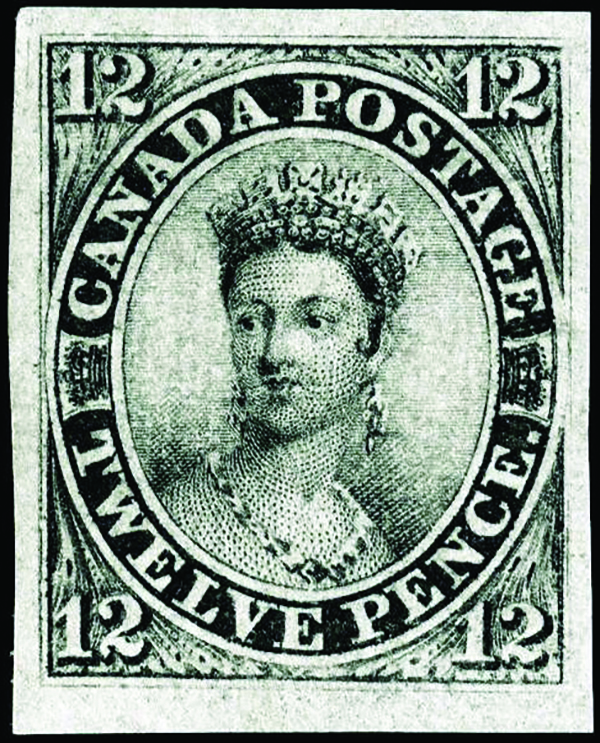
From commercial miscalculation to crown jewel of Canadian philately, the Province of Canada’s 12-pence black — known reverently as the “Black Empress” — has travelled an extraordinary path over the past 175 years. Issued on June 14, 1851, it began as an ambitious expression of postal independence and ended as one of the rarest and most coveted stamps in the nation’s history.
As collectors prepare to mark its 175th anniversary, the story of the 12-pence black reads like a philatelic drama. Only 1,450 of the 51,000 printed were ever sold, with the remainder destroyed — a commercial failure that ultimately created a legendary rarity. Today, an estimated 150 examples survive, including just five unused copies.
Its mystique was reaffirmed in 2024 when a mint pair from the Ron Brigham Collection realized $625,000 plus buyer’s premium at Eastern Auctions, setting a new Canadian record for a philatelic item sold at auction. The fierce bidding battle underscored what collectors have long known: the Black Empress occupies rarefied air.
Beyond its market value, the stamp carries artistic and historical weight. Featuring the elegant “Chalon Head” portrait of Queen Victoria — derived from Alfred Edward Chalon’s 1837 painting — it reflects a young colony asserting control over its postal system and identity.
In the full feature, we revisit the birth, failure and ultimate triumph of Canada’s most iconic classic — a fragile survivor that, 175 years later, still defines the pinnacle of Canadian philately.
This fascinating feature is part of the latest issue of Canadian Stamp News (Vol. 50 #24, March 10-23, 2026), released Feb. 24, and also includes stories on a national philatelic survey, a new “Freestyle Philately” display and Canadians shining at Dubai in February.