
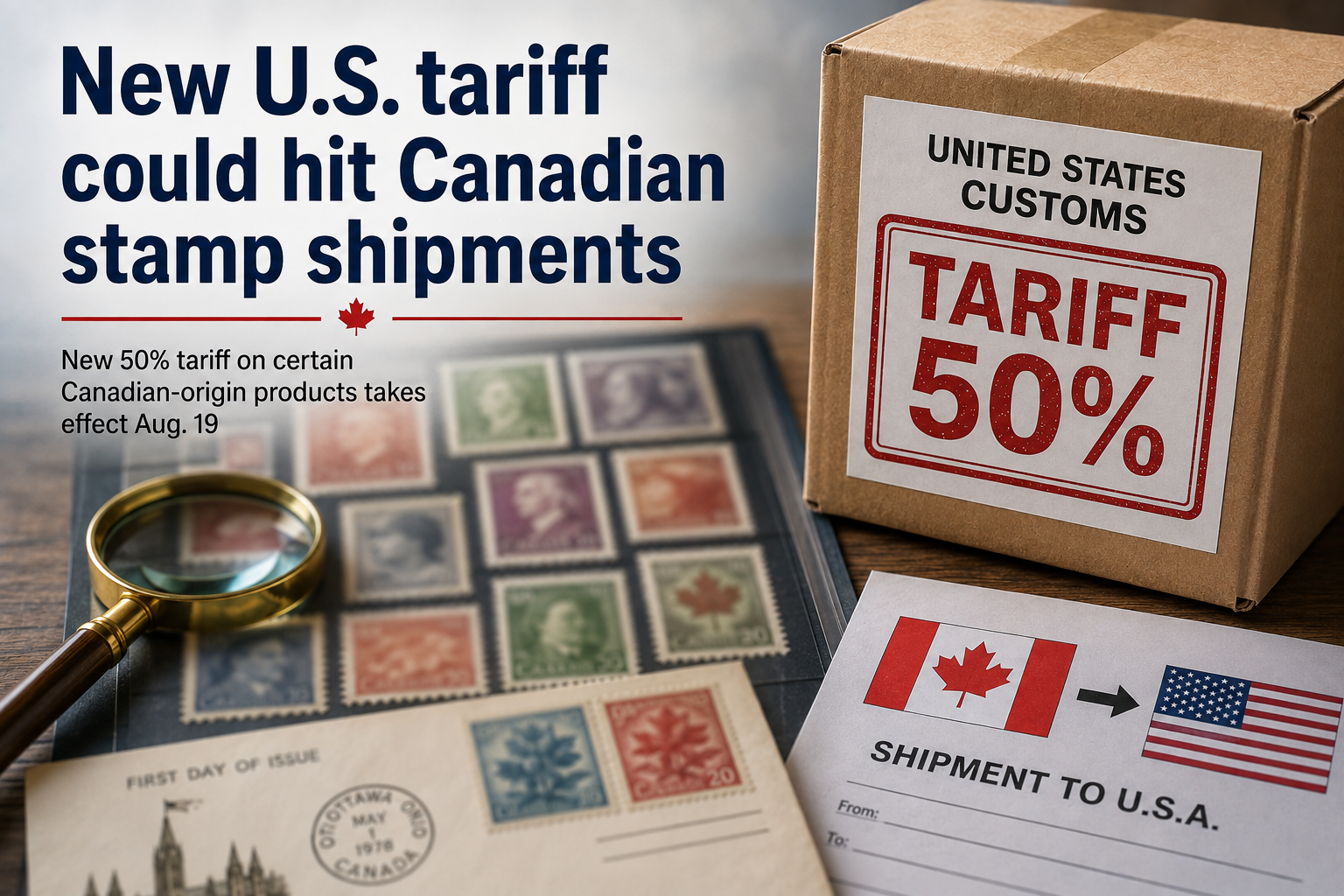
Canadian stamp dealers selling to collectors in the United States could face a significant new obstacle beginning Aug. 19, with certain Canadian-origin philatelic material potentially subject to an additional 50 per cent U.S. tariff.
The Canadian Stamp Dealers Association (CSDA) has alerted its members to the issue, advising dealers to review their U.S.-bound shipments and consult their customs brokers, carriers or shipping providers about how the new tariff could affect their businesses.
Of particular concern to the philatelic trade is the inclusion of U.S. tariff classification HTSUS 9704.00.00 among the Canadian products targeted by the new measure. The classification covers postage and revenue stamps, stamp-postmarks, first-day covers, postal stationery and similar material, used or unused, other than material falling under heading 4907.
The issue is especially significant because U.S. Customs and Border Protection (CBP) addressed the classification of foreign stamps in an October 2025 binding ruling. In that case, involving foreign postage stamps and a first-day cover being imported for collectors and dealers, CBP determined the material was properly classified under HTSUS 9704.00.0000. CBP’s ruling included unused foreign postage because it was not valid for payment of postage in the United States and instead had philatelic value.
If covered Canadian-origin philatelic material is assessed the additional 50 per cent duty, the financial implications could be substantial. A Canadian stamp shipment with a customs value of $200 US, for example, could potentially attract an additional $100 US in duty before other applicable charges.
In its letter to members, the CSDA cautioned that this does not mean dealers should attempt to change the tariff classification of their shipments to avoid the new duty. Instead, the association recommended members confirm the appropriate classification and country of origin with their customs broker, carrier or shipping provider.
The association has also received reports that the effects may already be showing up in shipping systems. One Canadian stamp dealer reported that UPS was already applying the 50 per cent tariff to impacted stamp shipments ahead of Aug. 19. The dealer also reported that Canada Post’s Zonos system was calculating the 50 per cent tariff on impacted stamps.
The CSDA advisory acknowledged there remains hope the measure could be changed or avoided. The federal government continues negotiations with the U.S. administration, with relief from the new tariffs among Canada’s objectives ahead of the Aug. 19 implementation date.
“CSDA is hopeful that an agreement can be reached that avoids this additional burden on Canadian stamp dealers and their U.S. customers,” the association told members.
Until an official change is announced, however, the CSDA is advising dealers to prepare on the basis that the tariff will take effect. Dealers may also want to alert U.S. customers to the possibility of additional import charges before completing or shipping an order.
The association said it will continue monitoring developments and keep its membership informed as additional information becomes available. It is also encouraging dealers who receive information from customs brokers, carriers or other reliable sources – or who encounter the new tariff themselves – to share those details with the CSDA so relevant information can be passed along to other members.
The potential consequences extend beyond individual transactions. The United States represents an important market for Canadian stamp dealers and auction houses, and a 50 per cent additional duty on affected Canadian material could influence buying decisions by American collectors, particularly on higher-value purchases.
With the implementation date approaching and Canada-U.S. negotiations continuing, dealers on both sides of the border will be watching closely to see whether the measure takes effect as announced or whether a last-minute agreement provides relief.