
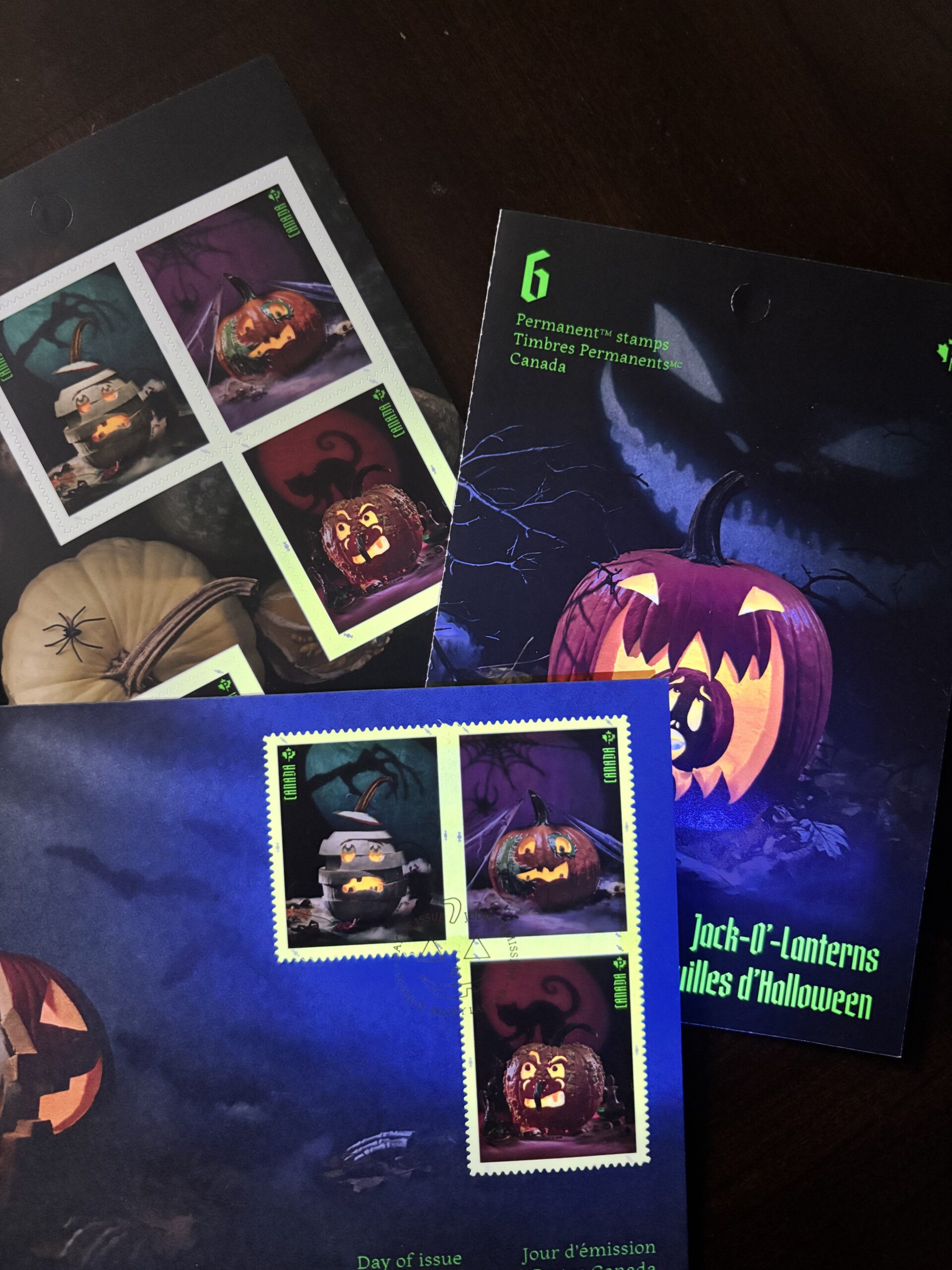
Canada Post has confirmed its 2026 Halloween stamps contain deliberately concealed design elements and special fluorescent inks that become visible under ultraviolet (UV) light, adding an unexpected collecting dimension to the seasonal issue.
The confirmation follows an Oct. 13 report by the philatelic blog Philaquely Moi, which documented glowing jack-o’-lantern faces and additional images appearing around the borders of the three stamps when examined under UV light.
In response to an inquiry from Canadian Stamp News, Canada Post confirmed Oct. 30 that the effects were intentionally incorporated into the stamps using two distinct production techniques.
“The jack-o’-lantern stamps incorporate two distinct production techniques that can be seen under ultraviolet (UV) light,” explained Valérie Chartrand of Canada Post Media Relations.
The first involves fluorescent inks integrated into the designs. When exposed to ultraviolet light, the inks react to create a glowing effect visible under a black light.
The second technique involves images embedded within the stamps’ phosphor tagging, a coating commonly associated with automated mail processing.
According to Canada Post, selected areas of the phosphor coating were deliberately omitted to create hidden shapes and design details.
“In these phosphor areas, a series of intentional ‘knockouts’, or spaces where the phosphor coating has been omitted, become visible under UV light,” Chartrand explained.
“These ‘knockouts’ can appear as additional shapes or design details around the stamp borders and were deliberately included as hidden elements for collectors to discover.”
The confirmation establishes that the unusual effects reported by Philaquely Moi were part of the original stamp designs rather than unexpected reactions involving the printing materials.
The collector-focused website, which specializes in glow-in-the-dark and ultraviolet stamp effects, first highlighted the features in an Oct. 13 posting. Its photographs showed portions of the carved pumpkins illuminating under UV light, along with small shapes resembling Halloween treats appearing around the stamp borders.
Canada Post subsequently supplied Canadian Stamp News with an additional image illustrating the issue, providing further material for collectors interested in examining the stamps.
HIDDEN DETAILS
FOR COLLECTORS
The three jack-o’-lantern stamps, issued Oct. 13, feature a Mummy, Witch and Monster, each created from an actual hand-carved pumpkin.
While their colourful designs were intended to capture the spirit of Halloween, the ultraviolet effects introduce another dimension to an issue already distinguished by elaborate pumpkin carvings and atmospheric photography.
Canada Post’s original announcement described the three designs and their production but did not specifically identify the fluorescent inks or hidden images within the phosphor tagging.
The newly confirmed details provide collectors with an additional reason to examine the stamps, particularly those interested in security features, unusual printing techniques and special effects.
Ultraviolet light has long played a role in philately, helping collectors identify fluorescent and phosphorescent materials used in postal production.
Fluorescent inks react to ultraviolet illumination by emitting visible light, while phosphor tagging is commonly used to assist automated mail processing. By selectively omitting portions of the tagging, printers can create patterns or images which become apparent under suitable lighting.
In the case of the Halloween stamps, the hidden details complement the seasonal theme, turning an examination of the issue into something resembling a Halloween treasure hunt.
Canada Post’s explanation confirms the effects are visible under UV light. It does not establish whether the stamps continue glowing after the ultraviolet light is removed.
THREE CARVED
PUMPKIN DESIGNS
The original stamp designs were created by Kristine Do, with pumpkins carved by Zac Flavelle, photography by Maya Visnyei and prop styling by Catherine Doherty.
The Mummy features a bandaged pumpkin with glowing eyes, while the Monster has a stitched face and an illuminated grin. The Witch is distinguished by a crooked nose and a setting filled with Halloween imagery.
The issue was printed by Colour Innovations and released in booklets of six Permanent domestic-rate stamps, with two examples of each design.
An official first day cover was also issued, featuring a jack-o’-lantern-shaped cancellation from Smoky Lake, Alta., known as the Pumpkin Capital of Alberta.
Canada Post’s online store lists a production quantity of 180,000 for the stamp booklet product and 5,000 for the official first day cover.
The newly confirmed ultraviolet features add to the appeal of the issue for collectors of modern Canadian stamps, particularly those interested in unusual printing techniques and intentionally concealed design elements.
The original discovery was documented by Philaquely Moi in its Oct. 13 report, while Canadian Stamp News previously covered the issue when the stamps were released.
With Halloween arriving Oct. 31, Canada Post’s confirmation gives collectors another reason to revisit the issue — and perhaps discover a few hidden treats of their own.
Collectors who examine the stamps under ultraviolet light are encouraged to share their observations and photographs with Canadian Stamp News, taking care not to look directly into the UV light.