
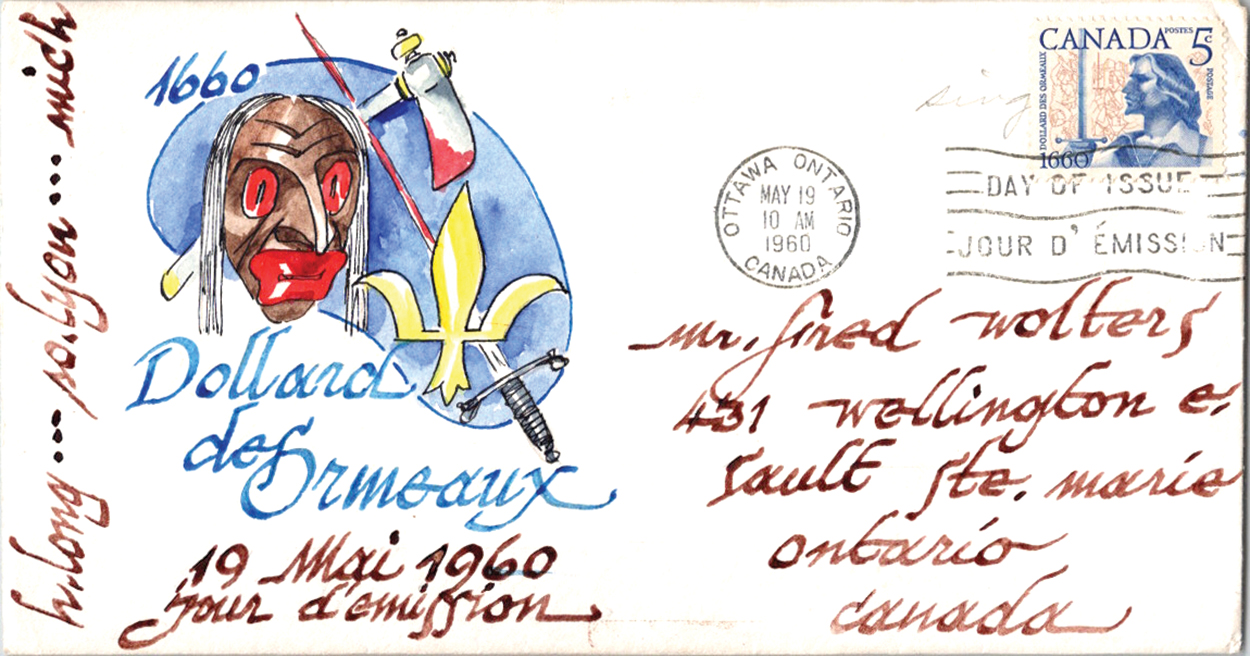
A group of 21 colourful first-day covers dating from the late 1950s through the mid-1960s has revealed much more than an assortment of unusual hand-made cachets. Tucked inside several of the envelopes were handwritten notes, preliminary designs, extra stamps and other pieces of ephemera offering clues to a decades-old collecting friendship.
The covers were created by H. Long of South Lyon, Mich., and sent primarily to Canadian collector Fred Wolters, whose addresses over the years included Sault Ste. Marie, Timmins and Cambrai, Ont. Their surviving correspondence suggests the two men shared more than stamps, with Long writing about fishing trips, gardening, yard work and other parts of everyday life.
But it is Long’s comments about his cachets that make the material particularly intriguing. Notes accompanying several covers reveal the challenges he encountered researching stamp subjects, developing suitable designs and preparing his creations in time for first-day servicing.
One surviving card provides an even rarer glimpse behind the finished product. Long sketched ideas for a Trans-Canada Highway cachet incorporating provincial emblems before deciding the concept was “too complicated to squeeze into a corner of an envelope.” His completed covers range from simple inscriptions to colourful drawings, maps and even maple leaves constructed from typewritten asterisks.
Among the most intriguing pieces are matching Canadian and U.S. covers commemorating the June 26, 1959 opening of the St. Lawrence Seaway. Carrying closely related hand-coloured cachets, the pair shows Long creating complementary designs for both sides of the joint Canada-U.S. stamp issue.
More than six decades later, much about Long and Wolters remains unknown. But the covers — and what remained hidden inside some of them — preserve something catalogues seldom capture: the ideas, frustrations, deadlines and friendship behind a collector’s creations.
Read the full story in the latest issue of Canadian Stamp News.